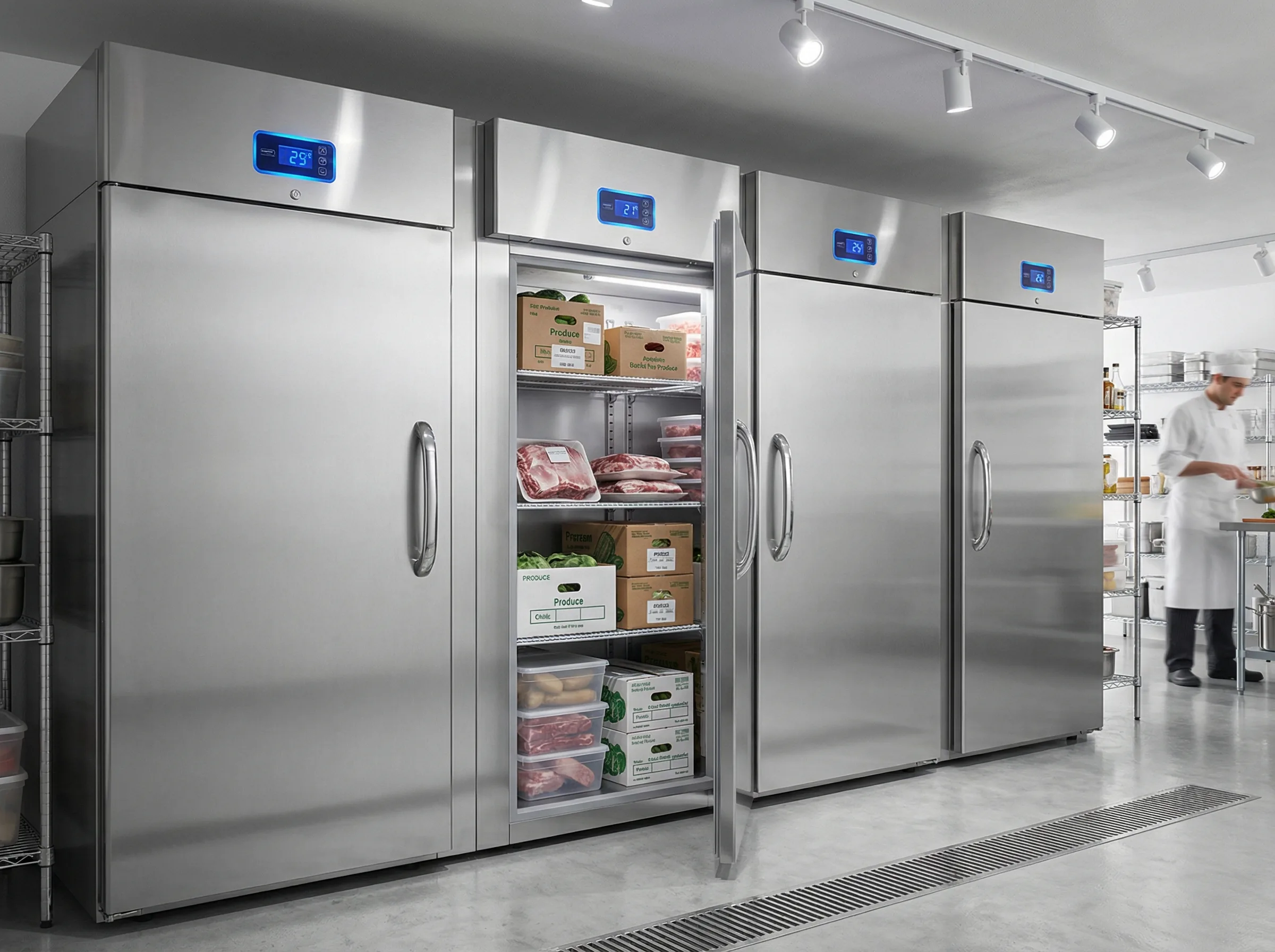
Blast Chiller Repair & Installation in Los Angeles
HACCP-compliant rapid cooling for restaurants, catering companies, and food production facilities. When food safety is on the line, you need same-day repair.
Here's the rule that keeps LA health inspectors busy: cooked food has to go from 135°F to 41°F within 6 hours. The first drop from 135°F to 70°F has to happen within 2 hours. Try doing that with 40 gallons of soup in a standard walk-in cooler. You can't. The walk-in can't pull heat out of a large batch fast enough, so the food sits in the bacterial danger zone for hours. That's how foodborne illness outbreaks start, and it's exactly why blast chillers exist.
A blast chiller pushes high-velocity cold air across food at -40°F to pull the temperature down fast. A properly working unit takes a full hotel pan of cooked chicken from 160°F to 38°F in about 90 minutes. When that unit breaks, your entire prep schedule and food safety plan breaks with it.
Arctic Cool Refrigeration repairs and installs commercial blast chillers across Greater Los Angeles. We've worked with high-volume restaurants, catering operations, hotel kitchens, commissary kitchens, and food production facilities since 1984. We understand that a broken blast chiller isn't a "schedule it for next week" situation. It's a "fix it today or we can't produce tomorrow" emergency.
Common Blast Chiller Problems We Fix
Not Reaching Target Temp
The unit runs but food doesn't hit 38°F within the cycle time. Usually a weak compressor, low refrigerant charge, or restricted airflow from dirty evaporator coils.
Probe Sensor Failures
Core temperature probes read incorrectly or not at all. The unit thinks the food is cold when it isn't. Critical for HACCP compliance and food safety logging.
Compressor Overload
Blast chillers run high-capacity compressors that work hard. Overheating, short cycling, or tripping the breaker means the compressor needs attention before it fails completely.
Control Board Errors
Digital control panels on Irinox, Alto-Shaam, and Traulsen units display error codes. Could be a sensor issue, a board failure, or a communication problem between components.
Fan Motor Failure
The high-velocity fans that push cold air across the food are critical. When they fail, cooling time doubles or triples, defeating the purpose of the blast chiller.
Door Gasket & Seal Issues
Blast chillers run at extreme temperatures. Door gaskets crack and harden faster than on standard coolers. Warm air infiltration kills efficiency and extends cycle times.
Blast Chiller Brands We Service
We work on every commercial blast chiller brand used in the Los Angeles food service market:
- Irinox — the gold standard in blast chilling. MultiFresh and EasyFresh models used by the best kitchens in LA. Italian engineering with sophisticated controls.
- Traulsen — TBC series blast chillers. Reliable American-made units popular in hotel and institutional kitchens.
- Alto-Shaam — QC series blast chillers and combi oven/blast chiller combos. Common in chain restaurants and commissary operations.
- Piper Products — RCM series. Solid mid-range blast chillers for restaurants and catering.
- Beverage-Air — blast chillers built on their commercial refrigeration platform. Good value for medium-volume operations.
- Randell, Master-Bilt, American Panel — walk-in blast chiller rooms and custom installations for large-scale food production.
Why LA Restaurants Need Blast Chillers
Los Angeles has one of the strictest health inspection programs in the country. The LA County Department of Public Health conducts unannounced inspections, and improper cooling is one of the most common violations that leads to score deductions. Here's what happens in practice:
- A restaurant cooks 50 lbs of pulled pork for weekend catering. Without a blast chiller, that pork sits in hotel pans in the walk-in for 6-8 hours before hitting safe temperature. With a blast chiller, it's at 38°F in 90 minutes. The health inspector asks for your cooling log. Which story do you want to tell?
- A commissary kitchen preps 200 meals for delivery. Each batch needs to be cooled, packaged, and labeled with temperature data. A blast chiller with a core probe gives you documented proof of safe cooling. A walk-in cooler gives you guesswork.
- A catering company produces sauces, soups, and stocks in large batches. Liquid foods are the hardest to cool because of their thermal mass. A blast chiller handles this. A standard cooler cannot.
Blast Chiller vs. Shock Freezer
People use these terms interchangeably, but they're different cycles:
- Blast chill cycle: Drops food from 160°F to 38°F in ~90 minutes. Used for food that will be refrigerated and served within a few days. Most restaurants use this cycle daily.
- Blast freeze (shock freeze) cycle: Drops food from 160°F to 0°F in ~4 hours. Used for long-term frozen storage. Locks in texture and moisture that slow freezing destroys. Catering companies and food production facilities use this for batch prep.
- Most commercial blast chillers do both. You select the cycle based on what you're storing. We service both functions and calibrate the probes and timers for each cycle.
Who We Serve
Blast chillers are becoming standard equipment in serious food operations across LA:
- High-volume restaurants doing large-batch prep. If you're cooking proteins, stocks, or sauces in quantity, you need a blast chiller to cool safely and on schedule.
- Catering companies that prep hundreds of meals in advance. Blast chilling is the only way to meet food safety timelines at scale.
- Hotel kitchens with banquet operations. Room service, event catering, and restaurant service all depend on rapid cooling for batch prep.
- Commissary and ghost kitchens producing for multiple brands or delivery platforms. Volume demands rapid, documented cooling.
- Food production facilities making packaged meals, sauces, dressings, or baked goods for wholesale distribution. HACCP plans require documented blast chilling.
- School and hospital food service where strict food safety protocols are non-negotiable and inspections are frequent.
Installation and Sizing
Thinking about adding a blast chiller to your kitchen? We handle the full installation including electrical, plumbing (for water-cooled condensers), and ventilation. The right size depends on your production volume:
- Undercounter/countertop models (3-5 pans): $3,000-$8,000. Good for small restaurants and cafes.
- Roll-in models (20-40 pans): $12,000-$25,000. Standard for high-volume restaurants and catering kitchens.
- Walk-in blast chiller rooms: $30,000-$80,000+. For commissary kitchens and food production facilities processing hundreds of pounds daily.
We help you choose the right capacity based on your actual production volume, not a manufacturer's brochure. Oversizing wastes money. Undersizing means you're running multiple cycles and losing time.
Frequently Asked Questions
It rapidly cools cooked food from 160°F to 38°F in about 90 minutes, meeting FDA Food Code requirements to keep food out of the bacterial danger zone (41°F-135°F). Essential for food safety compliance in any commercial kitchen doing batch prep.
$300-$2,000 depending on the issue. Probe sensors: $150-$350. Fan motors and control boards: $300-$700. Compressor replacement: $800-$2,000. We provide a written estimate before starting.
Irinox, Traulsen, Alto-Shaam, Piper Products, Beverage-Air, Master-Bilt, Randell, and American Panel. Countertop, roll-in, and walk-in blast chiller rooms.
Not explicitly required, but the FDA Food Code cooling timelines are effectively impossible to meet with large batches using only standard refrigeration. Health inspectors recommend blast chillers as the standard solution, and improper cooling is one of the most common violations.
About 90 minutes from 160°F to 38°F for blast chilling. About 4 hours from 160°F to 0°F for blast freezing. If your unit takes significantly longer, it needs service.
Service Areas
Food Safety Can't Wait. Neither Should You.
Same-day blast chiller repair for restaurants and food production across Greater Los Angeles.
📞 (800) 685-5590