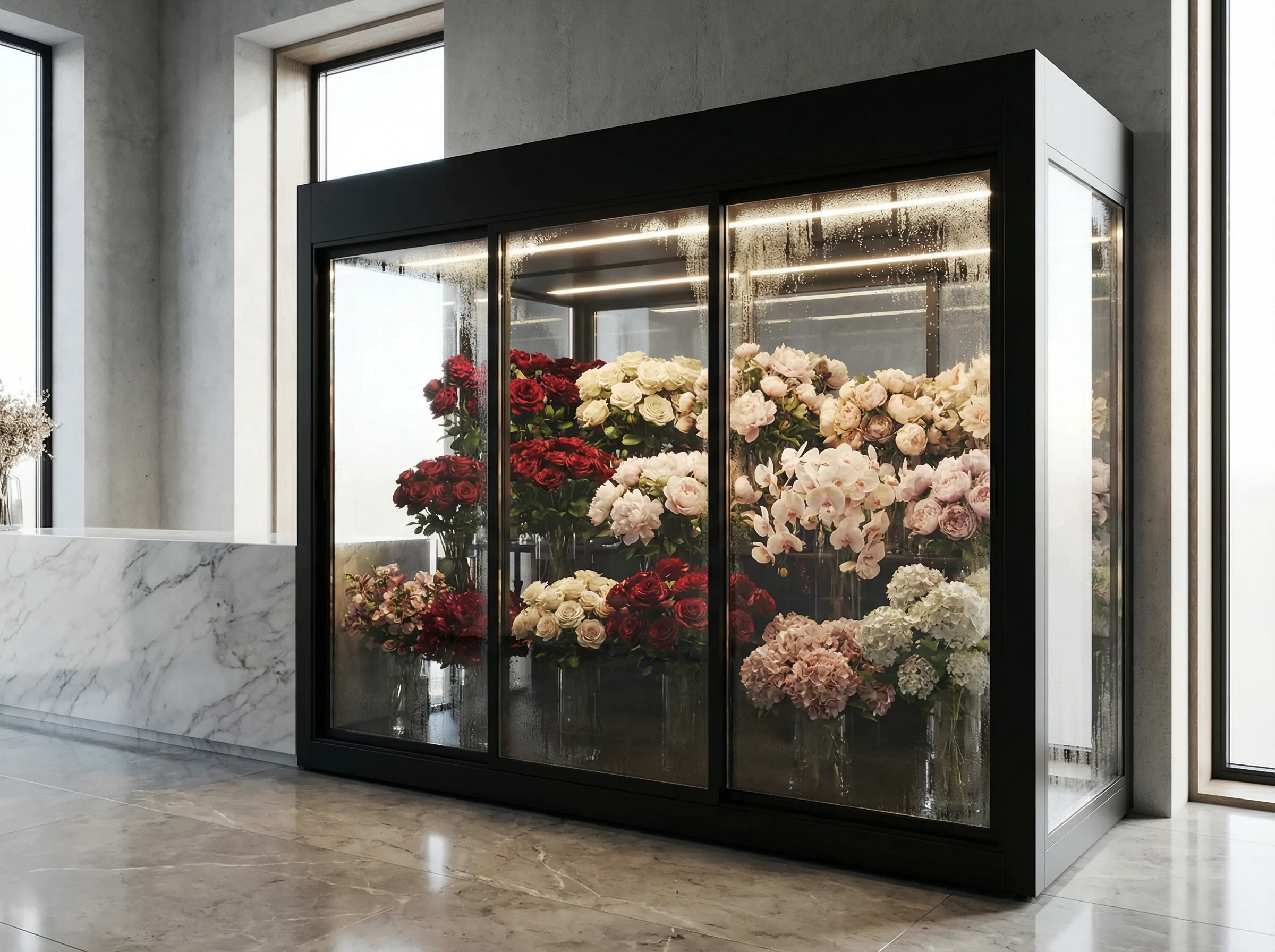
Flower Cooler Repair in Los Angeles
Precise temperature and humidity control for florists, grocery floral departments, event companies, and wholesale distributors throughout Greater Los Angeles.
A flower cooler is not a regular refrigerator. Send a general appliance technician to work on one and you will likely lose inventory. Standard refrigeration pulls moisture out of the air — that is the opposite of what cut flowers need. Floral coolers are engineered to maintain high humidity (80-95% relative humidity) while holding tight temperature ranges, and the margin for error is measured in degrees, not comfort zones. Set a cooler 4 degrees too cold and you will freeze the cell walls of roses, turning petals brown within hours. Set it 4 degrees too warm and you will cut the vase life of every stem in the room by half. Arctic Cool Refrigeration has been servicing floral refrigeration in Los Angeles for over 40 years, and our technicians understand the difference between a cut flower environment and a food service walk-in.
Humidity matters as much as temperature in floral storage — arguably more. A flower cooler operating at 34°F with 60% humidity will dehydrate petals and wilt stems faster than a cooler running at 38°F with 90% humidity. Most refrigeration companies do not understand this relationship. They show up, check the compressor, verify the thermostat reads 36°F, and leave — while your roses are drying out because the evaporator coil is oversized and stripping moisture from the air. Our technicians measure both temperature and humidity on every service call, and we calibrate the entire system to protect your specific inventory. If you stock tropicals alongside standard cut flowers, we know that means separate zones or a carefully balanced compromise — not a single setpoint and a prayer.
Common Flower Cooler Problems
Flower cooler failures have distinctive symptoms that an experienced floral refrigeration technician will recognize immediately. Here are the six issues we diagnose and repair most frequently across Los Angeles florists and grocery floral departments.
Temperature Fluctuations
Thermostat drift, compressor short-cycling, or a failing expansion valve causing temperature swings of 5-10 degrees. Cut flowers need stability within 1-2 degrees — anything wider accelerates ethylene production and shortens vase life dramatically.
Humidity Too Low
Dehydrated petals, curling leaf edges, limp stems, and dramatically shortened vase life. Usually caused by an oversized evaporator coil, excessive defrost cycles, or poor air circulation that creates dry spots within the cooler.
Humidity Too High
Botrytis (gray mold) on rose petals, condensation dripping onto blooms, and soft brown spots on delicate flowers like gardenias and peonies. Caused by poor air circulation, a failing condensate drain, or a cooler packed too tightly for proper airflow.
Compressor Failure
Complete loss of cooling. For a florist with $3,000-$10,000 in perishable inventory, this is a genuine emergency. We carry replacement compressors sized for Heatcraft, Bohn, Larkin, and other common floral cooler condensing units.
Frost & Ice Buildup
Ice on evaporator coils or cooler walls signals a defrost system failure — bad defrost timer, failed heater element, or a stuck defrost termination thermostat. Blocked airflow from ice buildup creates warm pockets that rot stems nearest the blockage.
Door Gasket Deterioration
Worn or torn gaskets on walk-in doors or display case glass allow warm, dry air to infiltrate the cooler constantly. The compressor runs overtime trying to compensate, energy bills spike, and the humidity balance is destroyed.
Types of Flower Coolers We Service
Walk-In Flower Coolers
The backbone of any serious florist operation. Walk-in flower coolers range from 6x6 rooms in neighborhood flower shops to 20x30 cold rooms in wholesale operations like those on Wall Street in the LA Flower District. These units require precise humidity control systems — typically a separate humidifier or a low-TD (temperature differential) evaporator coil that cools air slowly to minimize moisture removal. We service all walk-in configurations including Norlake, American Panel, Bally, and custom-built insulated panel rooms. Common repairs include condensing unit replacement, evaporator coil cleaning and repair, humidifier maintenance, door gasket and closer replacement, and drain line clearing.
Display Flower Coolers
Glass-front merchandising coolers used by grocery store floral departments, high-end flower shops, and hotel lobbies. Brands like Borgen Systems, Floral Merchandising Systems (FMS), and Powers Equipment build display coolers specifically for floral — with forced-humidity systems, LED lighting that does not generate heat, and multi-deck shelving designed for bucket display. We repair compressor systems, replace fan motors, fix lighting, reseal glass doors, and recalibrate temperature and humidity controls. If your grocery store display case is wilting flowers faster than you can sell them, call us before you lose another week of inventory.
Reach-In Floral Coolers
Compact one- or two-door units used by smaller flower shops, checkout counters in grocery stores, and grab-and-go bouquet displays. True, Beverage-Air, and Turbo Air all make reach-in units adapted for floral use, but many shops repurpose standard beverage coolers — which lack proper humidity control and dry out flowers within days. We retrofit humidity systems into existing reach-in units and repair all standard components including thermostats, door gaskets, condenser coils, and compressors.
Custom Floral Cold Rooms
Large-scale custom installations for wedding venues, event production companies, and high-volume florists who need to store hundreds of arrangements at controlled temperatures before delivery. These rooms often have multiple temperature zones — one area at 34°F for standard cut flowers and a separate zone at 52°F for tropicals and orchids. We design, install, and service custom floral cold rooms with independent refrigeration circuits, separate humidity controls, and ethylene filtration systems. If you run a wedding operation out of a venue in Malibu or Beverly Hills and need a cold room that can hold 200 centerpieces overnight without a single wilted petal, that is exactly what we build.
What Makes Flower Cooler Repair Different
Sending a standard HVAC technician or general refrigeration company to repair a flower cooler is like sending a plumber to fix a gas line — technically adjacent, practically dangerous. Here is what makes floral refrigeration a specialty trade:
Humidity control is the entire game. A food service walk-in cooler targets 35-38°F and nobody cares if humidity drops to 50%. A flower cooler needs 33-36°F and 85-95% relative humidity simultaneously. That requires a low-TD evaporator coil (typically 6-10°F temperature differential versus 15-20°F in a food cooler), slower fan speeds, and often a supplemental humidification system. A tech who does not understand TD ratios will "fix" a flower cooler by installing a standard evaporator — and your flowers will be dehydrated within 48 hours.
Ethylene gas management. Cut flowers produce ethylene gas as they age, and ethylene accelerates aging in nearby blooms. A properly ventilated flower cooler has controlled air exchange — enough to flush ethylene buildup without overwhelming the cooling system. Some high-end installations use ethylene scrubbers or activated carbon filtration. When we service a flower cooler, we check air exchange rates and ethylene management alongside the mechanical components.
Air circulation patterns matter. In a food walk-in, you want strong, even airflow to maintain consistent temperature throughout. In a flower cooler, aggressive airflow dehydrates blooms. The evaporator fans need to be positioned and speed-controlled so air circulates gently — enough to prevent warm spots and mold, but not so forcefully that it dries out open petals. We verify fan speed settings and airflow patterns on every flower cooler we service.
Temperature precision at a different scale. A restaurant walk-in holding at 38°F versus 40°F is a minor variance. A flower cooler holding at 38°F versus 33°F is the difference between roses lasting 5 days and roses lasting 12 days. Our technicians calibrate thermostats and temperature controllers to within 1°F accuracy, and we verify readings with independent digital thermometers — not just the unit's built-in display.
Optimal Flower Storage Conditions
Different flowers have different cold storage requirements. Setting a single cooler to 36°F is a reasonable starting point for a mixed retail shop, but knowing the precise ranges separates a good florist from one that constantly loses inventory. We calibrate coolers based on what you actually stock:
| Flower Type | Temperature | Humidity | Notes |
|---|---|---|---|
| Roses, Carnations, Chrysanthemums | 33-35°F | 90-95% | Standard cut flowers. Can tolerate near-freezing. Maximize vase life at the low end. |
| Tropical Flowers (Orchids, Birds of Paradise, Anthuriums) | 50-55°F | 70-80% | Chill-sensitive. Below 50°F causes brown spots and petal blackening within hours. |
| Mixed Bouquets (Retail Display) | 36-38°F | 85-90% | Compromise range for mixed inventory. Acceptable for most standard cut flowers. |
| Greens & Foliage (Ferns, Eucalyptus, Ruscus) | 34-36°F | 90-95% | High humidity critical. Greens dehydrate faster than flowers in low-humidity coolers. |
| Peonies | 33-35°F | 90-95% | Store tight buds cold to control bloom timing. Pull to room temp 24-48 hours before use. |
| Lilies | 33-35°F | 90-95% | Remove pollen-bearing anthers before storage to prevent staining. Cold tolerant. |
| Tulips | 33-35°F | 90-95% | Continue growing in water even when refrigerated. Store upright to prevent stem curving. |
| Gardenias & Stephanotis | 40-45°F | 85-90% | Bruise easily. Handle minimally. Semi-tropical — too cold turns petals brown. |
If you stock both standard cut flowers and tropicals in the same cooler, you have a problem that requires either a two-zone system or a carefully managed compromise temperature around 42-45°F. That compromise will shorten the vase life of your roses and extend the life of your orchids. We can help you find the right balance — or design a two-zone solution if your volume justifies the investment.
Who We Serve
- Retail Florists — neighborhood flower shops, boutique florists, and high-end design studios. Your walk-in cooler and display case are your entire business. When they fail, your inventory is at risk and your reputation is on the line.
- Grocery Store Floral Departments — Ralphs, Vons, Whole Foods, Trader Joe's, Gelson's, and independent markets across LA. Display cooler failures mean wilted product on the sales floor and write-offs that hit your department's margin.
- Wedding & Event Venues — Malibu Rocky Oaks, Calamigos Ranch, The Houdini Estate, Beverly Wilshire, and dozens of other LA-area venues that store floral arrangements overnight before events. A cooler failure the night before a $50,000 wedding is not an option.
- Wholesale Flower Distributors — operations in and around the LA Flower District on Wall Street (between 7th and 8th on San Pedro and Wall). Walk-in coolers holding thousands of bunches need to run 24/7 without temperature drift.
- Funeral Homes & Mortuaries — floral coolers holding sympathy arrangements that must look perfect for services. Temperature and humidity are critical because arrangements sit for extended periods before display.
- Hotels & Hospitality — lobby floral displays, banquet centerpieces, and guest room arrangements for properties like the Beverly Hills Hotel, Waldorf Astoria Beverly Hills, and Shutters on the Beach. Floral programs at these properties move through inventory quickly and demand consistent cooler performance.
Flower Cooler Service Areas in Greater Los Angeles
Arctic Cool Refrigeration dispatches from Calabasas and covers the full Greater Los Angeles area for floral refrigeration service. We know the flower industry geography of this city — from the wholesale markets downtown to the boutique florists in the Palisades.
- LA Flower District (Downtown) — the heart of LA's floral industry. Wall Street, San Pedro Street, and the surrounding blocks between 7th and 8th Streets. We service walk-in coolers for wholesalers, importers, and distributors operating out of this district. When a cooler goes down holding $20,000 in imported Dutch roses, same-day response is not a luxury — it is a necessity.
- Beverly Hills & Bel Air — high-end florists, luxury hotel floral programs, and event companies serving the Westside's most demanding clientele.
- Malibu — wedding venues and estate florists. Salt air accelerates corrosion on condenser coils and electrical connections. We know what to look for in coastal installations.
- Santa Monica & Brentwood — retail florists, grocery floral departments, and hotel properties along the coast.
- West Hollywood & Hollywood — event production companies, studio florists, and boutique shops serving the entertainment industry.
- Calabasas & Westlake Village — our home base. Typically on-site within 1-2 hours for local florists and grocery stores.
- Woodland Hills & Sherman Oaks — Valley florists, grocery chains, and event companies along Ventura Boulevard.
- Burbank & Glendale — studio-adjacent florists, Armenian and international flower markets, and grocery floral departments.
- Pasadena & San Gabriel Valley — neighborhood florists, event venues, and the full 626 corridor. Rose Parade country — we know flowers here.
- South Bay & Torrance — retail florists, grocery stores, and funeral home floral coolers throughout the South Bay.
Flower Cooler Repair FAQ
What temperature should a flower cooler be set to?
It depends entirely on what you are storing. Standard cut flowers like roses, carnations, and chrysanthemums store best at 33-35°F with 90-95% relative humidity. Tropical flowers like orchids, birds of paradise, and anthuriums need 50-55°F — anything below 50°F causes chilling injury that turns petals brown or black. Mixed retail displays typically run at 36-38°F as a compromise. If you stock both tropicals and standard cuts, you either need two separate temperature zones or a managed compromise. Arctic Cool Refrigeration calibrates your cooler based on your actual inventory mix — not a generic setpoint.
How much does flower cooler repair cost in Los Angeles?
Flower cooler repair costs range from $150 to $900+ depending on the issue. Thermostat calibration or door gasket replacement runs $150-$300. Fan motor or humidity control system repair is $250-$500. Compressor replacement — the most expensive repair — ranges from $500-$900+ depending on the unit size and whether it is a self-contained display cooler or a walk-in with a remote condensing unit. We provide a written estimate before starting any work. No surprises on the invoice.
Why are my flowers wilting even though the cooler shows the right temperature?
Nine times out of ten, the answer is humidity. A cooler can hold a perfect 35°F readout while the relative humidity sits at 50-60% — far too dry for cut flowers. The evaporator coil may be oversized (pulling too much moisture), the defrost cycle may be running too frequently, or the door gaskets may be leaking dry ambient air into the cooler. We measure both temperature and humidity on every service call. If the temperature is correct but flowers are dehydrating, the humidity system needs attention — not the thermostat.
Do you repair walk-in flower coolers and display cases?
Yes, both. We service walk-in flower coolers (insulated panel rooms with remote or self-contained refrigeration) and glass-front display coolers used by grocery stores and retail florists. Walk-in services include compressor repair, evaporator coil service, humidity system repair, door gasket replacement, and drain line clearing. Display cooler services include glass door reseal, fan motor replacement, LED lighting repair, and temperature/humidity recalibration. We work with all major floral cooler manufacturers including Borgen, FMS, Heatcraft, Bohn, and Norlake.
Can you install a new flower cooler for my flower shop?
Yes. We handle full flower cooler installations for florists, grocery stores, and event venues throughout Los Angeles. That includes site assessment, electrical and plumbing coordination, insulated panel installation (for walk-ins), refrigeration system sizing and installation, humidity control system setup, and final temperature and humidity calibration. We size the evaporator coil specifically for floral use — low temperature differential to preserve humidity — rather than repurposing a food service coil that will dry out your inventory. We also install ethylene filtration systems for high-volume operations.
Related Services
Service Areas
Flowers Wilting? Cooler Down? Call Now.
Same-day flower cooler repair across Greater Los Angeles. 40+ years of floral refrigeration expertise.
Call (800) 685-5590