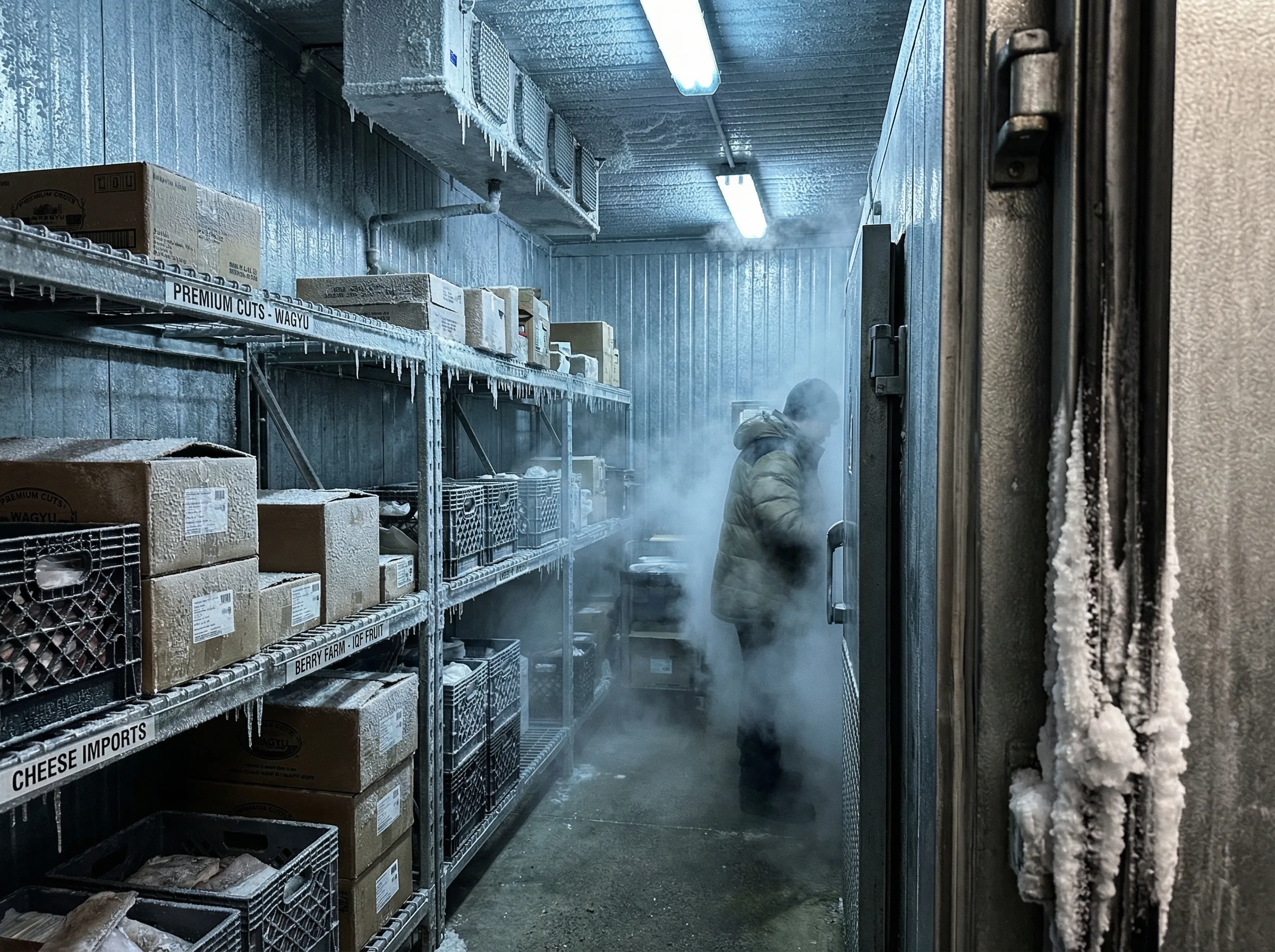
Walk-In Freezer Repair & Installation in Los Angeles
24/7 emergency service, compressor repair, defrost systems, panel installation. Restaurants, grocery stores, warehouses, food distributors.
Quick Answer · Updated April 2026
Walk-in freezer repair in Los Angeles typically runs $450–$2,800 per service call. New 8x10 installations run $14,000–$28,000. Retrofits for existing units run $4,500–$12,000. Arctic Cool services all major brands (Kolpak, Master-Bilt, Heatcraft, Nor-Lake) with same-day repair and turnkey installation since 1984. C-38 licensed (CSLB #1062503). Call (800) 685-5590 for 24/7 emergency dispatch.
A walk-in freezer emergency is not a walk-in cooler emergency. When a cooler drifts up to 45°F, you've got a window — maybe 12 hours — to move product and get it fixed. When a walk-in freezer climbs from -10°F to 20°F, every case of frozen seafood, every pallet of USDA prime cuts, every tub of ice cream base starts thawing. The value per cubic foot inside a commercial walk-in freezer is typically 2-3x what's in a cooler. A 10x10 freezer packed with frozen protein can hold $15,000-$40,000 in product. At 20°F, all of it is compromised within 4-6 hours. The health department doesn't care why it happened — they care that your product hit the danger zone.
Arctic Cool Refrigeration has been handling walk-in freezer emergencies across Los Angeles since 1984. We dispatch from Calabasas and cover the entire Greater LA area — Valley, Westside, Hollywood, South Bay, and out to Pasadena. Our trucks carry Copeland and Bitzer compressor components, defrost heater elements, expansion valves, contactors, and the refrigerant blends specific to low-temperature systems. When you call (800) 685-5590, a live person answers and gets a tech rolling. We don't do callbacks. We don't do "next available appointment." Your freezer is down, your money is melting, and we treat it accordingly.
Common Walk-In Freezer Problems
Walk-in freezers operate under harsher conditions than any other refrigeration equipment in your building. Lower evaporator temperatures, higher pressure differentials, electric defrost heaters cycling multiple times per day — there's more that can fail, and failures escalate faster. These are the six problems we see most often on emergency calls.
Not Holding Temperature
Box temp creeping above 0°F when it should be sitting at -10°F. The compressor may be losing pumping capacity after years of short-cycling. Could be a slow refrigerant leak — walk-in freezers running R-404A or R-448A are especially sensitive to charge levels. Or the condenser coil is caked with grease and lint, forcing the high side pressure up until the system can't pull the box down. We measure superheat, subcooling, and amp draw before we touch anything.
Compressor Failure
The single most expensive walk-in freezer repair — $1,200 to $3,500+ depending on the unit. Freezer compressors work harder than cooler compressors. Lower suction pressures, higher compression ratios, more heat. We replace with OEM-spec units from Copeland (Scroll and Discus series), Bitzer (semi-hermetic screws for larger boxes), and Tecumseh. We also check the root cause — a compressor that burned out from liquid slugging will burn out the replacement too if you don't fix the expansion valve.
Excessive Ice & Frost Buildup
Walk-in freezers build ice faster and heavier than coolers because the coil surface runs well below 0°F. When the defrost system fails — burned-out electric heater elements, bad defrost timer or clock, failed termination thermostat — the evaporator coil buries itself in ice within 48-72 hours. Airflow drops to nothing. The compressor runs non-stop trying to compensate. This is the #1 call we get on walk-in freezers, and it's almost always the defrost system.
Door & Strip Curtain Issues
Walk-in freezer doors take more punishment than cooler doors — they're heavier (thicker insulation panels), the gaskets freeze to the frame, and the heater wires embedded in the door frame to prevent ice seal-up burn out over time. When that frame heater dies, the door freezes shut or won't seal properly. Strip curtains inside the doorway wear out from daily traffic and stop blocking warm air infiltration. Both drive up energy costs and strain the refrigeration system.
Defrost Drain Freeze-Up
This is a freezer-specific problem that coolers rarely deal with. The condensate drain line runs from the evaporator drain pan out of the box. In a freezer, that line passes through a wall that's -10°F on one side. Without a functioning drain line heater, the water refreezes inside the pipe and blocks it completely. Water backs up into the drain pan, overflows onto the evaporator coil, freezes solid, and suddenly you have an ice dam blocking all airflow. We replace drain line heaters and clear the blockage — usually in under two hours.
Evaporator Coil Icing
Different from defrost failure — this happens when the refrigerant system itself is off. Low charge means the coil is too cold in spots and too warm in others, creating uneven frost. A stuck-open or failed thermostatic expansion valve (TXV) floods liquid refrigerant into the coil, dropping the surface temp and causing rapid ice formation. A partially blocked liquid line drier starves the coil. We diagnose by checking superheat at the coil outlet — that tells us exactly what the refrigerant is doing inside the evaporator.
Walk-In Freezer vs. Walk-In Cooler — Key Differences
Customers sometimes assume a walk-in freezer is just a colder version of a walk-in cooler. It's not. The engineering is fundamentally different, and so is the repair work. Here's what separates the two:
- Operating temperatures: Coolers hold 33°F-40°F. Freezers hold -10°F to 0°F. That 40-50 degree difference changes everything about how the refrigeration system is sized, charged, and controlled.
- Refrigerants: Coolers typically run R-134a or R-290 for medium-temp applications. Freezers need low-temperature blends — R-404A, R-448A (Solstice N40), R-407F — designed to achieve the lower evaporating temperatures required. Different refrigerants, different pressures, different oil compatibility.
- Defrost systems: Most coolers use off-cycle defrost — the compressor shuts off and the coil warms naturally above 32°F. Freezers can't do that because the box itself is below 0°F. They need active defrost — electric resistance heaters mounted to the evaporator coil, or hot-gas defrost that routes discharge gas through the coil. These systems add complexity and more failure points.
- Insulation thickness: Cooler panels are typically 4" thick (R-25 to R-28). Freezer panels run 5" to 6" (R-32 to R-40) to handle the greater temperature differential. The doors are heavier, the hardware is beefier, and the panels need heater wires in the joints to prevent ice bridging.
- Compressor sizing: Freezer compressors work at lower suction pressures and higher compression ratios than cooler compressors. They generate more heat, draw more amps, and have shorter lifespans if the system isn't maintained. A 2-HP compressor that easily handles a walk-in cooler would be completely inadequate for the same size freezer.
- Drain line heaters: Coolers don't need them — the drain line runs through ambient-temperature space. Freezer drain lines pass through sub-zero walls and need electric heaters to prevent the condensate from refreezing and blocking the line. When these heaters fail, you get ice buildup on the floor and coils.
Bottom line: walk-in freezer repair requires a technician who understands low-temperature refrigeration — not someone who only works on coolers and reach-ins. Our team has 40+ years of experience specifically with commercial freezer systems across Los Angeles.
Walk-In Freezer Brands We Service
We work on every major walk-in freezer brand installed in the Greater Los Angeles market. Our trucks carry parts for the units we see most often, and we have supplier relationships for everything else — typically same-day or next-day delivery on specialty components.
- Nor-Lake — one of the most common walk-in freezer panel systems in LA restaurants. We service their self-contained and remote refrigeration configurations.
- Master-Bilt — heavy-duty walk-in freezer systems used in grocery, food processing, and high-volume kitchens. Known for reliable panels, but the refrigeration components need regular attention.
- American Panel — prefabricated panel systems widely used in new LA restaurant build-outs. CAM-lock assembly. We handle panel replacement, floor repair, and refrigeration retrofits.
- Kolpak — a Welbilt brand, common in chain restaurant installations. We service their standard and heavy-duty freezer configurations.
- Bally — commercial and industrial walk-in freezers. Older Bally units are still running all over LA — we keep them alive and know when it's time to replace.
- US Cooler — modular freezer panel systems for restaurants, convenience stores, and warehouse operations.
- Heatcraft — condensing units and evaporator coils. Heatcraft Bohn and Larkin units are the refrigeration backbone of thousands of walk-in freezers across Greater LA. We service, rebuild, and replace.
- Copeland — the most widely used compressor brand in commercial walk-in freezers. Scroll compressors for smaller boxes, Discus semi-hermetics for larger applications. We stock the most common models.
- Bohn — evaporator coils and unit coolers for walk-in freezer applications. We replace fan motors, defrost heaters, and complete coil assemblies.
- Russell — evaporators and condensing units, especially common in grocery and food distribution walk-in freezers.
- Larkin — another Heatcraft brand. Unit coolers and coils for low-temperature applications. We see these in meat processing and cold storage facilities throughout LA.
Walk-In Freezer Installation
Installing a walk-in freezer is a different project than installing a walk-in cooler. The insulation requirements are stricter, the refrigeration system is larger, the electrical draw is higher, and the defrost system has to be selected and wired correctly from day one. A mistake during installation doesn't show up immediately — it shows up six months later when the compressor burns out or the floor panels buckle from ice heaving.
Panel Assembly & Insulation
Walk-in freezer panels require 5" to 6" polyurethane-injected insulation — thicker than cooler panels — to maintain the temperature differential between a 75°F kitchen and a -10°F box. Every panel joint gets sealed with vapor barrier tape and caulk. The floor panels need to be rated for the load — a freezer full of frozen product on pallets puts serious weight on those panels. We install on concrete slabs with vapor barriers underneath to prevent moisture migration and ice heaving that can crack your floor in the first winter.
Refrigeration Sizing
Undersizing a freezer's refrigeration system is the most common installation mistake we see from other contractors. They use cooler sizing charts and add 20% — that's not how it works. Freezer BTU calculations must account for the product pull-down load (bringing room-temp product to -10°F), infiltration load (every door opening dumps warm humid air into the box), defrost heat load (electric heaters add heat to the box multiple times per day), and the transmission load through walls, floor, and ceiling. We size using manufacturer engineering data, not rules of thumb.
Defrost System Selection
Electric defrost is the standard for most commercial walk-in freezers under 1,000 sq ft. Heater elements mount directly to the evaporator coil and cycle 2-4 times per day, controlled by a defrost timer and terminated by a thermostat mounted to the coil. Hot-gas defrost — where discharge gas from the compressor is routed through the evaporator — is more efficient for larger systems and reduces the heat load added to the box, but it's more complex to pipe and control. We recommend the right system for your box size and usage pattern.
Electrical & Permits
Walk-in freezers draw significantly more power than coolers. Between the compressor, condenser fan, evaporator fan motors, defrost heaters, door frame heaters, drain line heaters, and interior lighting, a typical walk-in freezer installation requires a dedicated 30-50 amp circuit. California Title 24 energy compliance governs insulation R-values, lighting efficiency (LED only in new installations), and electronically commutated (EC) fan motors. We handle all permit applications and coordinate with LA County, City of Los Angeles, Calabasas, Burbank, and other local jurisdictions. Every installation passes inspection on the first visit.
Service Areas in Greater Los Angeles
Arctic Cool Refrigeration dispatches from Calabasas and covers the full Greater Los Angeles area. We own the western corridor — Calabasas to Malibu to the San Fernando Valley — and extend east through Hollywood, Downtown, and Pasadena.
- Calabasas — home base. On-site in 1-2 hours for local commercial clients.
- Thousand Oaks — restaurant row and Janss Marketplace food service operations
- Agoura Hills — commercial kitchens and food operations along the 101 corridor
- Westlake Village — hotels, country clubs, and upscale dining operations
- Woodland Hills & West Hills — Ventura Blvd restaurant corridor, grocery stores, catering facilities
- Chatsworth & Northridge — industrial food processing, cold storage warehouses, restaurant chains
- Sherman Oaks & Encino — dense restaurant concentration along Ventura Blvd, grocery market walk-in freezers
- Tarzana — food retail, specialty markets, restaurant walk-in service
- Malibu — seafood restaurants and beachfront operations where salt air corrodes condenser coils twice as fast
- Beverly Hills — fine dining, hotel kitchens, catering operations. Zero tolerance for downtime.
- Santa Monica — high-volume beachfront restaurants, hotel food service, grocery operations
- Burbank — studio commissaries, production catering, Magnolia Park restaurant district
- Glendale — grocery markets, restaurant chains, food distribution operations along Brand Blvd
- Pasadena — Old Town restaurants, hospital food service, institutional kitchens across the 626
Walk-In Freezer Repair & Installation Costs in Los Angeles
Below are typical price ranges for walk-in freezer work across Greater Los Angeles. Every estimate is flat-rate and provided in writing before work begins.
| Service | Typical Cost Range |
|---|---|
| Walk-in freezer repair (typical service call) | $450–$2,800 |
| Door gasket / seal replacement | $180–$420 |
| Defrost heater / timer replacement | $280–$620 |
| Evaporator fan motor | $350–$700 |
| Refrigerant recharge (R-448A, R-404A) | $320–$580 |
| Compressor rebuild / replacement | $1,800–$3,500 |
| Retrofit existing walk-in (new system, old box) | $4,500–$12,000 |
| New 8x10 walk-in installation (turnkey) | $14,000–$28,000 |
Walk-In Freezer FAQ
How much does walk-in freezer repair cost in Los Angeles?
Walk-in freezer repair in Los Angeles typically runs $200 to $3,500+ depending on the problem. Defrost heater replacement or thermostat swap: $200-$500. Evaporator fan motor: $350-$700. TXV (expansion valve) replacement: $400-$900. Compressor replacement — the big one — ranges from $1,200 to $3,500+ depending on the compressor type and box size. Arctic Cool provides a written estimate before any work starts. No surprises on the invoice.
How quickly can you respond to a walk-in freezer emergency?
Same day — usually within a few hours. Walk-in freezer failure is a food safety emergency, and we treat it as one. Call (800) 685-5590 and a live dispatcher answers, confirms your location, and routes the nearest technician immediately. We dispatch 7 days a week across all of Greater Los Angeles. No voicemail, no callback queue.
Why does my walk-in freezer keep icing up even after defrost?
If ice keeps returning after the defrost cycle runs, one of three things is happening: the defrost heaters aren't generating enough heat to fully melt the ice (heater element partially burned out), the defrost timer isn't giving the cycle enough run time (common if someone shortened the duration to "save energy"), or the termination thermostat is opening too early before the coil is fully clear. We also check for a failed drain line heater — if the drain refreezes between defrost cycles, water backs up and re-ices the coil. This needs professional diagnosis. Don't chip ice off the coil with tools — you'll puncture a refrigerant tube.
What temperature should a walk-in freezer hold?
Commercial walk-in freezers should maintain -10°F to 0°F for safe long-term frozen storage. The FDA Food Code and LA County Health Department both require frozen food to be stored at 0°F or below. We set most units to -10°F to provide a safety margin — if the door gets left open during a busy service or the defrost cycle runs, the box recovers back to 0°F faster. If your freezer can't hold below 0°F, something is wrong with the refrigeration system and it needs service before you get a health inspection surprise.
Do you install new walk-in freezers in Los Angeles?
Yes. We handle complete walk-in freezer installation: site survey, panel assembly (Nor-Lake, American Panel, Master-Bilt, US Cooler), refrigeration system selection and installation, defrost system wiring, drain line heater installation, electrical hookup, Title 24 compliance, and permit coordination with LA-area building departments. We've installed walk-in freezers for restaurants, grocery stores, meat processors, seafood distributors, ice cream manufacturers, and warehouse cold storage operations throughout Greater Los Angeles for over 40 years.
What is a walk-in freezer retrofit and when do I need one?
A walk-in freezer retrofit replaces the refrigeration system (condenser, evaporator, compressor, controls) while keeping the existing insulated box and panels. It's the right call when your walk-in shell is structurally sound but the refrigeration equipment is at end of life, or when you need to upgrade to a newer refrigerant (R-448A, R-449A) to meet California 2026 phase-out rules. Retrofits run $4,500–$12,000 in Los Angeles — typically 40–60% the cost of a full new install. Arctic Cool provides a site assessment with photo-documented findings before quoting. Call (800) 685-5590.
How much does walk-in freezer installation cost in Los Angeles?
New walk-in freezer installation in Los Angeles typically runs $14,000 to $28,000 for a standard 8x10 unit (turnkey: site prep, panels, refrigeration system, defrost, drain, electrical, permits). Larger units (10x12 and up) run $22,000–$45,000. Pricing varies with Title 24 compliance requirements, existing electrical capacity, and whether the site needs a new concrete pad. Arctic Cool provides a flat-rate written quote after a free on-site assessment. Call (800) 685-5590.
Related Services
Related Services
Service Areas
Walk-In Freezer Down? Every Hour Counts.
24/7 emergency dispatch across Greater Los Angeles. EPA-certified technicians, parts on every truck, one-visit repairs.
Call (800) 685-5590