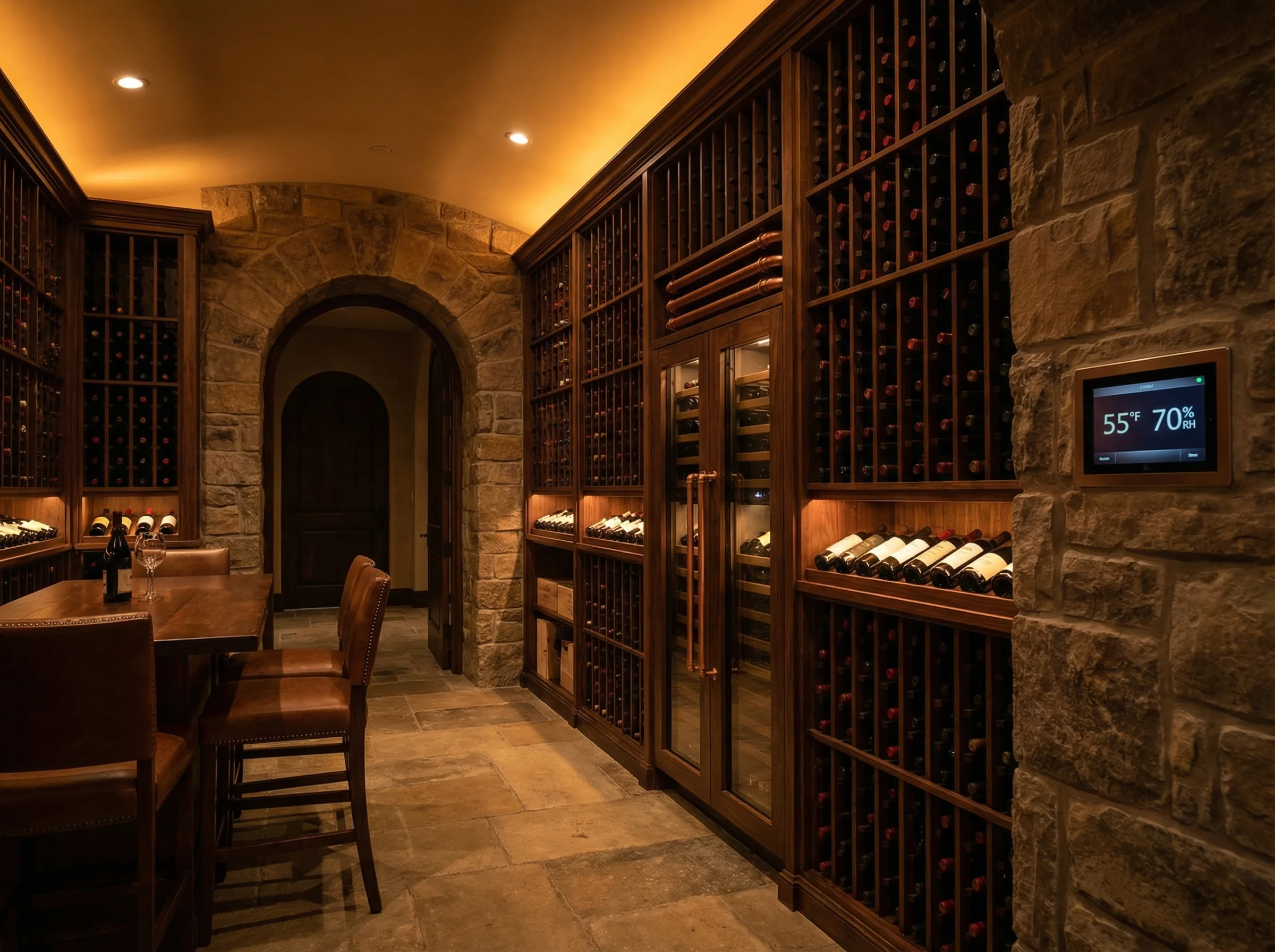
Quick answer: For a single-zone wine cooler, set it to 55°F — the universal storage temperature that protects all wine types. For dual-zone: 58-65°F upper zone for reds, 44-50°F lower zone for whites and sparkling.
In Los Angeles, always choose a compressor-based cooler over thermoelectric. LA kitchens hit 85-90°F in summer — thermoelectric units can't keep up. A wine cooler repair in LA typically runs $200-$500, well worth it to protect a collection.
Temperature Settings by Wine Type
Wine isn't one-size-fits-all for storage. Different wines need different temperatures.
If you have a dual-zone cooler, you can dial in both. Single-zone owners will need to compromise at 55°F.
Wine Storage Temperature Reference Guide
Wine Type
Storage Temp
Serving Temp
Notes
Full-bodied reds (Cabernet, Merlot, Syrah)
60-65°F
62-68°F
Below 55°F: tannins tighten, wine tastes flat
Light-bodied reds (Pinot Noir, Beaujolais)
55-60°F
58-64°F
Shows best fruit and aromatics slightly cooler
Full-bodied whites (Chardonnay, Viognier)
50-55°F
52-58°F
Don't over-chill; oaky Chardonnay at 42°F tastes flat
Light whites and rosé (Sauvignon Blanc)
45-50°F
46-52°F
Crisp and refreshing; acidity shines at lower temp
Sparkling (Champagne, Prosecco, Cava)
40-45°F
42-48°F
Coldest zone; warmer sparkling loses fizz faster
Dessert wines (Port, Sauternes)
55-60°F
55-65°F
Serve slightly warmer to open up complexity
The Universal Storage Temp
If you have a single-zone cooler storing mixed wines, set it to 55°F.
This is the universally accepted compromise. It won't be perfect for everything, but it won't damage anything either. Reds that need warmer serving temps can sit on the counter for 15-20 minutes before opening.
💡
Dual-zone setup tip: Put reds in the upper zone (naturally warmer, cold air sinks) and whites in the lower zone. Set upper to 60-65°F, lower to 44-50°F. This matches the physics of the cooler and reduces compressor strain.
Common Temperature Mistakes
These are the mistakes we see most often in LA homes and restaurants:
Setting It Too Cold
The mistake — treating the wine cooler like a regular refrigerator and setting it to 38-42°F.
What happens — wine goes dormant. Flavors mute, aromas disappear.
The visible sign — little glass-like shards on the cork. Tartaric acid crystals from over-chilling. Harmless but avoidable.
The fix — raise the temperature to 55°F minimum. Most wines recover within a few weeks.
Placing the Cooler in Direct Sunlight
The problem — west-facing LA kitchens get intense afternoon sun. The compressor works overtime to compensate.
What it causes — temperature swings, premature compressor wear, elevated energy bills.
UV damage — UV light degrades wine through glass doors. Breaks down organic compounds that create flavor and aroma.
The fix — relocate the cooler, add UV window film to the kitchen window, or apply UV film directly to the cooler door glass. Cost: $30-$50.
Overloading the Cooler
Rated capacity means actual capacity — a 46-bottle cooler is rated for 46 standard Bordeaux bottles, properly spaced.
What cramming does — restricts airflow, creates hot spots in the middle of the unit.
The temperature difference — bottles at the center of an overpacked cooler can be 5-8°F warmer than bottles near the cooling element.
Rule of thumb — fill to 80% of rated capacity for consistent temperature throughout.
Skipping Regular Maintenance
Dirty condenser coils — the #1 cause of temperature problems and premature failure. Clean every 6 months.
Worn door seal — warm air infiltration creates temperature fluctuations. Test: close the door on a dollar bill. If it slides out easily, the seal needs replacing.
Unlevel unit — even a slight tilt affects compressor oil circulation and door seal performance. Check with a level annually.
Ignored vibration — if you can feel the cooler vibrating when you touch it, the compressor mounts need attention.
⚠
In Los Angeles: Kitchens in the Valley (Calabasas, Encino, Woodland Hills) regularly hit 90°F+ in summer. Thermoelectric wine coolers max out at 20-25°F below ambient, meaning they may only reach 65-70°F when you need 55°F. In LA, compressor-based units are not optional for serious collections.
Signs Your Wine Cooler Needs Service
Temperature problems aren't always about settings. Sometimes the unit is failing. Watch for these:
Temperature swings of more than 3-4 degrees — wine coolers should hold within 1-2°F of the set point. Bouncing between 48 and 58°F means the thermostat, compressor, or door seal is failing.
Compressor running constantly — should cycle on and off throughout the day. Non-stop running signals a refrigerant leak, dirty condenser, or failing compressor.
Condensation inside the door — some fog when opening is normal. Persistent condensation on inside glass means a compromised door seal or humidity control malfunction.
Noticeable vibration — wine coolers should be nearly silent. Vibration disturbs sediment in aging wines and indicates a mechanical problem.
Compressor not starting — clicking sound without the compressor running means the start relay or capacitor has failed. Common on units 8+ years old.
Ice forming inside the cabinet — a defrost system failure. Ice restricts airflow and causes temperature instability.
Display showing incorrect temperature — thermistors drift over time. Cross-check with a standalone digital thermometer ($15-$25).
A wine cooler repair typically runs $200-$500 — well worth it for a collection worth protecting. We service Sub-Zero, U-Line, EuroCave, Vinotemp, Marvel, and every major brand across Los Angeles.
Wine Cooler Brands: How They Compare for LA
After servicing every major brand across Los Angeles for 40+ years, here's what we've seen:
Sub-Zero Wine Storage (400 and 600 Series)
Temperature stability — holds within 1°F of set point. Best in class.
UV-resistant glass — standard on all models. Protects against light degradation.
Vibration control — quietest compressor-based design on the market.
Repair cost — $250-$600 for most common issues. Parts shipping from US distributor adds 3-5 days.
Vinotemp
LA-local brand — based in Chatsworth, San Fernando Valley. Parts availability and service network are excellent in Southern California.
Mid-range EL series — $1,500-$3,000 with dual-zone capability. Good temperature stability at a lower price point.
Thermoelectric limitation — their popular small-collection thermoelectric units struggle in hot LA kitchens. Choose a compressor model for any kitchen placement.
Reliable performance — solid temperature stability, competitive with premium brands at a lower price.
Maintenance warning — condenser coils on under-counter installations are difficult to access without pulling the unit out. Schedule professional cleaning every 6-12 months or expect early compressor failure.
Humidity Control: The Factor Most Wine Owners Overlook
Temperature gets all the attention. Humidity is equally important.
Wine should be stored at 50-70% relative humidity. Here's what happens outside that range:
Below 50% humidity — corks dry out. A dried cork lets air into the bottle, which oxidizes the wine. Once oxidation starts, nothing reverses it.
Above 80% humidity — mold grows on labels and corks. Doesn't damage the wine itself, but destroys labels — matters if you ever plan to sell or trade bottles.
LA inland areas — Calabasas, Encino, Pasadena average 30-45% relative humidity, especially during Santa Ana wind events when humidity can drop below 15%.
LA coastal areas — Santa Monica, Marina del Rey average 65-75% relative humidity. Naturally in the ideal range.
Solutions for dry Valley homes:
Low-tech fix — place a small dish of water on the bottom shelf. Evaporation raises humidity inside the sealed cabinet.
EuroCave lava rock shelf — passive humidity management built into the unit. Absorbs and releases moisture to maintain ideal levels.
Sub-Zero moisture control — active humidity management built into the 600 series columns.
Dedicated wine room — CellarPro or WhisperKool cooling systems with integrated humidity control. Starting at $2,000-$3,000 for a 200-500 cubic foot room.
Five Storage Mistakes That Ruin Wine (Even in a Perfect Cooler)
You can spend $5,000 on the best wine cooler and still damage your collection with these mistakes:
Storing bottles upright — natural cork wines must be stored on their sides. An upright bottle allows the cork to dry out within 6-12 months, letting air in and oxidizing the wine. Screw caps and synthetic corks can go either way.
Opening the door too often — every time you open it, warm humid air rushes in. Restaurants are the worst offenders. If staff opens the cooler 30-40 times during dinner service, consider a separate pass-through unit for by-the-glass pours.
Storing wine near strong odors — cork is porous. Over months and years, garlic, onions, cheese, or cleaning chemicals can penetrate the cork and taint the wine. More of an issue with damaged door seals.
Ignoring UV light — UV breaks down the organic compounds that create flavor and aroma. If your cooler is near a window or under bright kitchen lights, check whether the door glass is UV-treated. Inexpensive fix: UV-blocking window film applied to the door glass, $30-$50.
Trusting the built-in thermometer blindly — built-in thermometers on many coolers drift 2-4°F over time without recalibration. Buy a $15-$25 standalone digital thermometer and place it inside. If it consistently reads differently from the display, your thermostat needs calibration or replacement ($150-$300).
For mixed storage in a single-zone cooler, set it to 55°F — the universal compromise that protects all wine types. For dual-zone coolers, set the upper zone to 55-65°F for reds and the lower zone to 40-50°F for whites and sparkling. Cold air sinks, so this setup is also more efficient for the compressor.
What is the difference between a single-zone and dual-zone wine cooler?
A single-zone cooler maintains one temperature throughout the entire cabinet. A dual-zone cooler has two independently controlled compartments. Dual-zone is essential if you store both reds and whites long-term, since reds need 55-65°F and whites need 45-55°F. Single-zone works fine for predominantly one type or if you set it to the 55°F compromise. Dual-zone coolers typically cost 20-40% more.
How much does wine cooler repair cost in Los Angeles?
Wine cooler repairs in LA typically cost $200-$500. Thermostat replacement runs $150-$300. Compressor replacement costs $400-$800 for standard brands and $600-$1,200 for premium units like Sub-Zero. Door gasket replacement is $100-$250. Fan motor replacement costs $150-$350. Service call fees are $89-$150, usually credited toward the repair.
Does vibration damage wine in a wine cooler?
Yes. Vibration disturbs sediment in aging wines and accelerates chemical reactions that degrade flavor and aroma. Thermoelectric wine coolers produce virtually no vibration because they have no compressor. Quality compressor-based coolers from EuroCave, Sub-Zero, and Vinotemp use vibration-dampening mounts that minimize this to acceptable levels. If you can feel your cooler vibrating when you touch it, the compressor mounts likely need adjustment.
Should I choose a thermoelectric or compressor wine cooler?
In Los Angeles, compressor-based coolers are almost always the better choice. Thermoelectric coolers are silent and vibration-free, but they can only cool to about 20-25°F below ambient temperature. In an LA kitchen that reaches 85-90°F in summer, a thermoelectric cooler may struggle to maintain 65°F. The exception is very small collections in climate-controlled rooms where ambient temperature stays below 75°F year-round.
How long do wine coolers last before needing replacement?
A quality compressor-based wine cooler lasts 10-15 years with proper maintenance. Premium brands like Sub-Zero and EuroCave can last 15-20 years. Thermoelectric coolers typically last 5-8 years. Budget models from unspecialized manufacturers often fail within 3-5 years. The most important maintenance tasks are cleaning condenser coils every 6 months, checking the door seal annually, and keeping the unit level.